
SUSTAINABILITY STRATEGY
Our vision: by 2030, sustainability will be part of everything we do
The University of Southampton’s vision is that by 2030, sustainability will be a part of everything the University does. This means embedding sustainability in our everyday behaviours, the way we work together, and the decisions we make as we pursue our mission of changing the world for the better.
The Sustainability Strategy 2026-2030 is one of the University’s 12 Strategic Plans and sets out how we will deliver our sustainability ambitions through six strategic Goals. These goals extend beyond reducing our environmental impact to embedding sustainability across our teaching, research, investment decisions and operational activities.
Climate change and wider environmental degradation present significant risks and challenges to society, the economy and the higher education sector. Universities have an important role to play, reducing their own environmental impacts while generating the knowledge, skills and evidence needed to support a more sustainable future. Through this Sustainability Strategy, the University of Southampton commits to continuing to reduce the environmental impacts of our operations while systematically integrating sustainability across our research, education and knowledge exchange activities. Our approach aligns with relevant national and international policy frameworks and supports our contribution to global sustainability challenges.
The Sustainability Strategy 2026–2030 builds on the foundations established through the Sustainability Strategy 2020–2025. The previous strategy created the institutional building blocks needed to support a more ambitious and balanced approach to sustainability. This refreshed Strategy reflects our transition from an inaugural framework to a more embedded, delivery-focused programme of work. Developed through extensive consultation across the University community, it responds to evolving environmental, social, policy and institutional contexts while providing a clear framework for achieving our six sustainability goals.
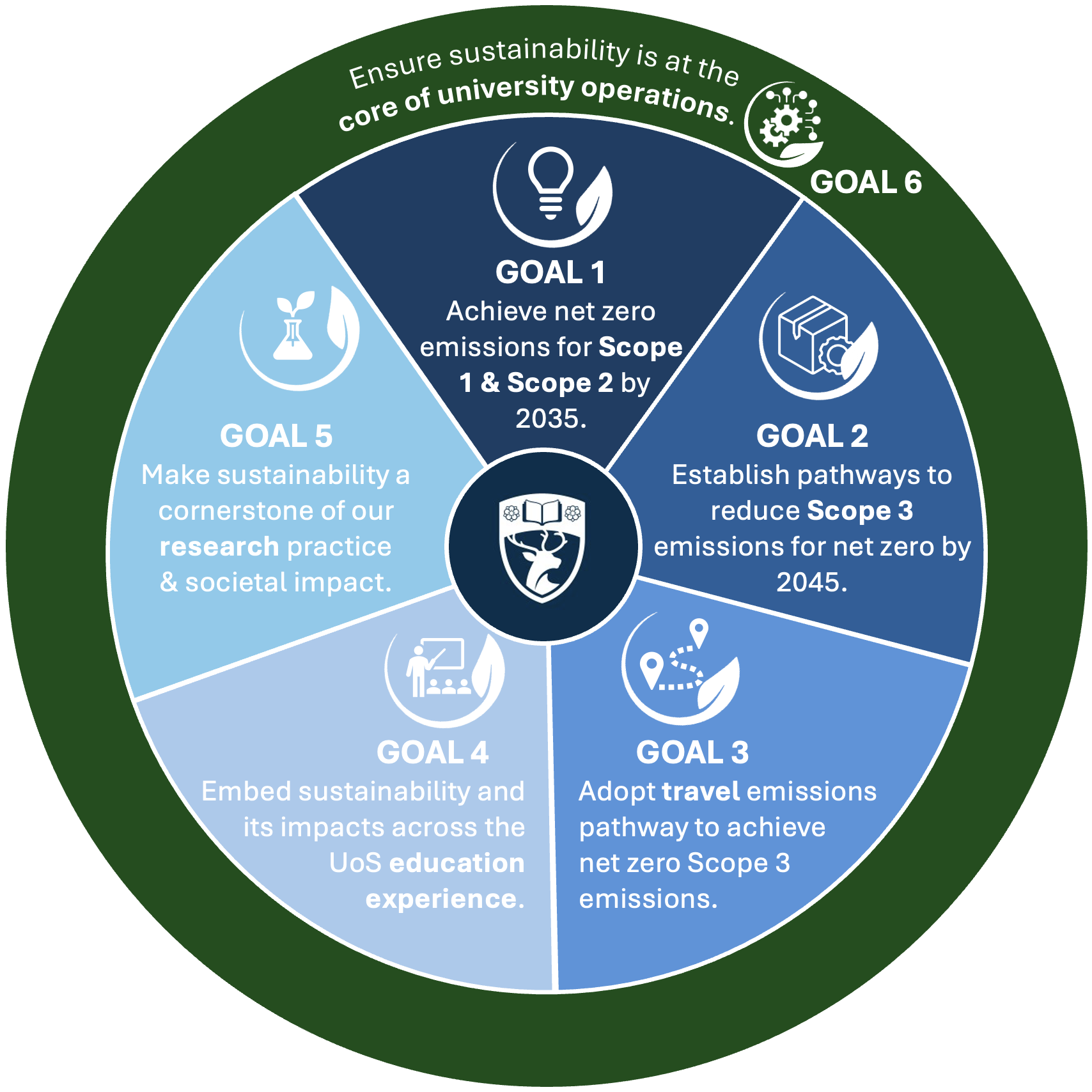
To deliver on the University’s vision, we have identified the following six Goals.
Governance
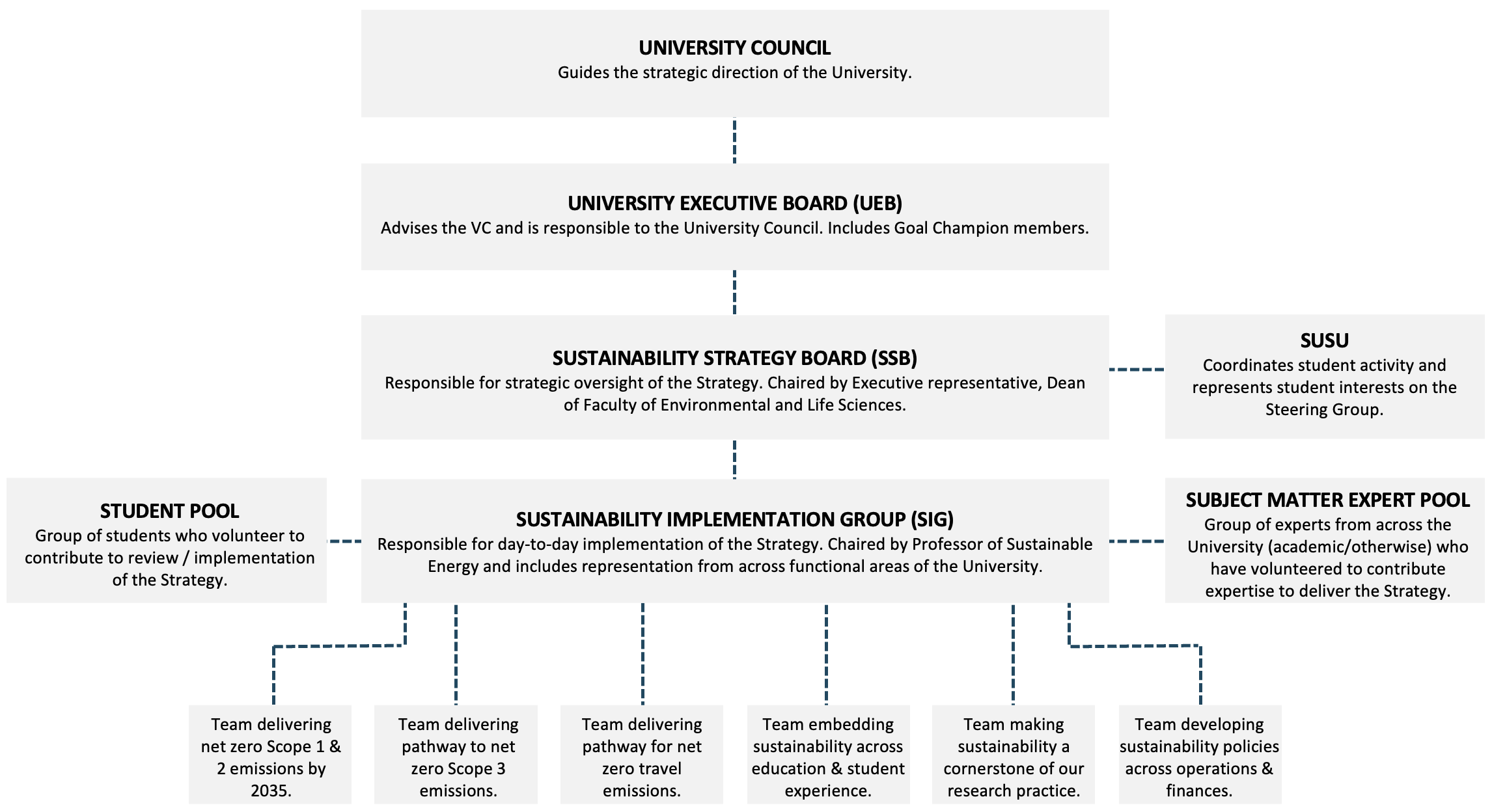
The Sustainability Strategy is supported by an agreed governance structure which ensures accountability across the University.
The Sustainability Implementation Group (SIG) oversees the day-to-day implementation of the Strategy and is chaired by Prof. AbuBakr Bahaj. SIG features Goal Leads, SUSU and Faculty / Professional Services representatives. SIG meets monthly and reports quarterly to the SSB.
The University Executive Board (UEB), chaired by the Vice Chancellor, has overall accountability for achieving Strategic Plans including that encompassed within the Sustainability Strategy.
GOAL 1: Achieve net zero for Scope 1 and 2 emissions by 2035
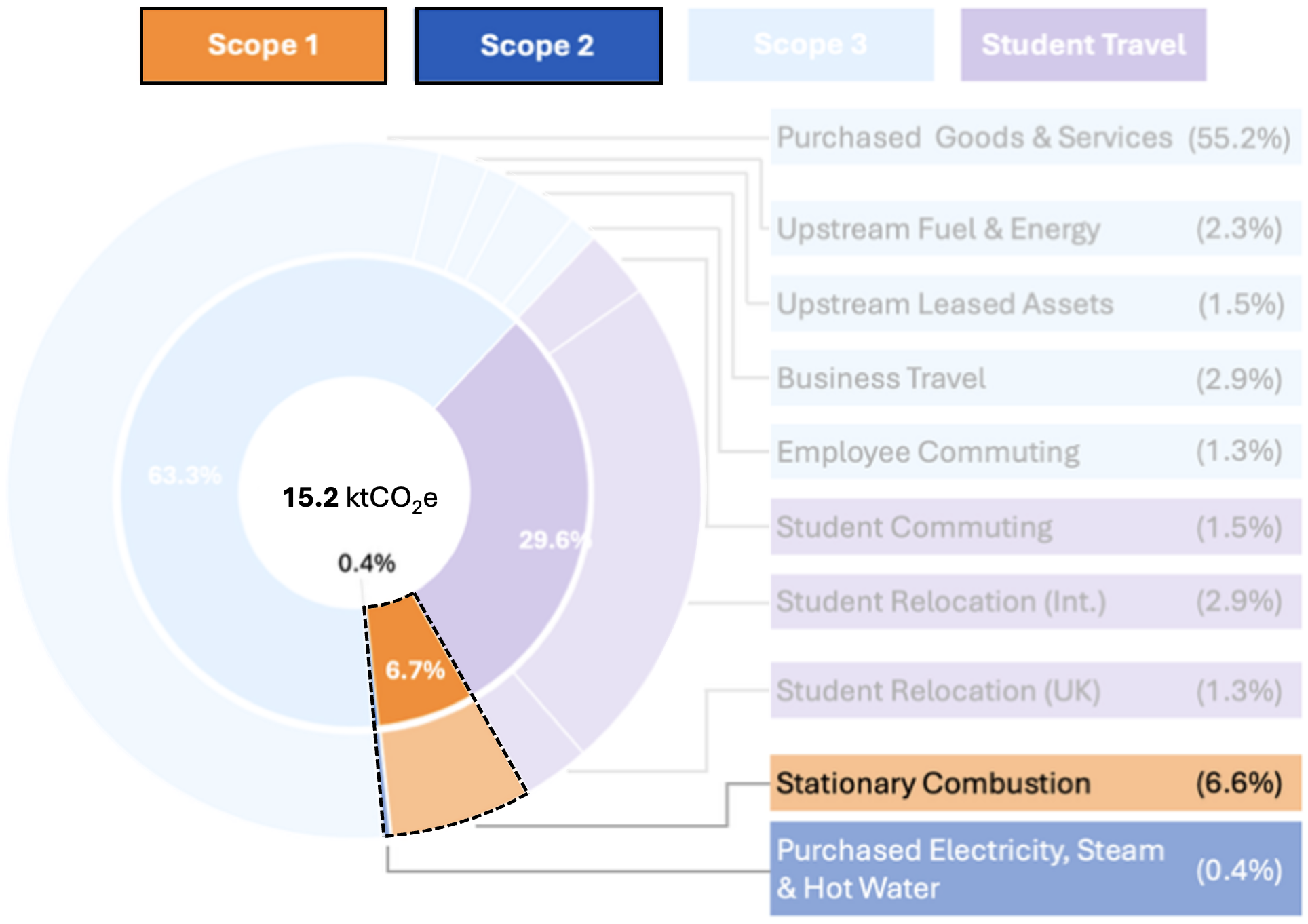
Goal 1 focuses specifically on Scope 1 & 2 emissions. These emissions cover direct (Scope 1) and indirect (Scope 2) emissions arising from energy usage on our residential and non-residential sites. We will develop and deliver plans to achieve net zero emissions across our estate by investing in renewable and low-carbon energy solutions, improving energy efficiency and space utilisation, and establishing clear pathways towards achieving net zero Scope 1 and 2 emissions by 2035.
TARGET: Establish a coherent route to reduce Scope 1 & 2 emissions in line with our 2035 net zero target, addressing power, heat & building retrofit.
Progress Highlights
Our latest reporting shows that in 2024-25 our Scope 1 and Scope 2 emissions were 14.3 ktCO2e and 0.9 ktCO2e respectively, representing approximately 7% of our total emissions (Scope 1, 2, and 3). This marks a 37% reduction from our 2018-19 baseline of Scope 1 and 2 emissions, largely driven by switching to a renewable electricity tariff in 2020-21. Scope 1 & 2 emissions continue to decline, the Strategy and its delivery, coupled with the Estates Master Plan now provide the required information to support the net zero trajectory for Scopes 1 and 2. This is being supported by a developed estate building level dashboard supporting data depository and modelling of solar power, refurbishments, heat pumps and geothermal.
-
Establish an Estates/SIG Goal 1 working group tasked to identify and progressively deliver tangible decarbonisation projects according to the net zero roadmap.
-
Assess suitability of buildings and formalise a programme to maximise onsite renewable generation.
-
Review our current energy metering infrastructure.
GOAL 2: Establish pathways to reduce Scope 3 emissions by inter-Scope 3 classification & supplier engagment
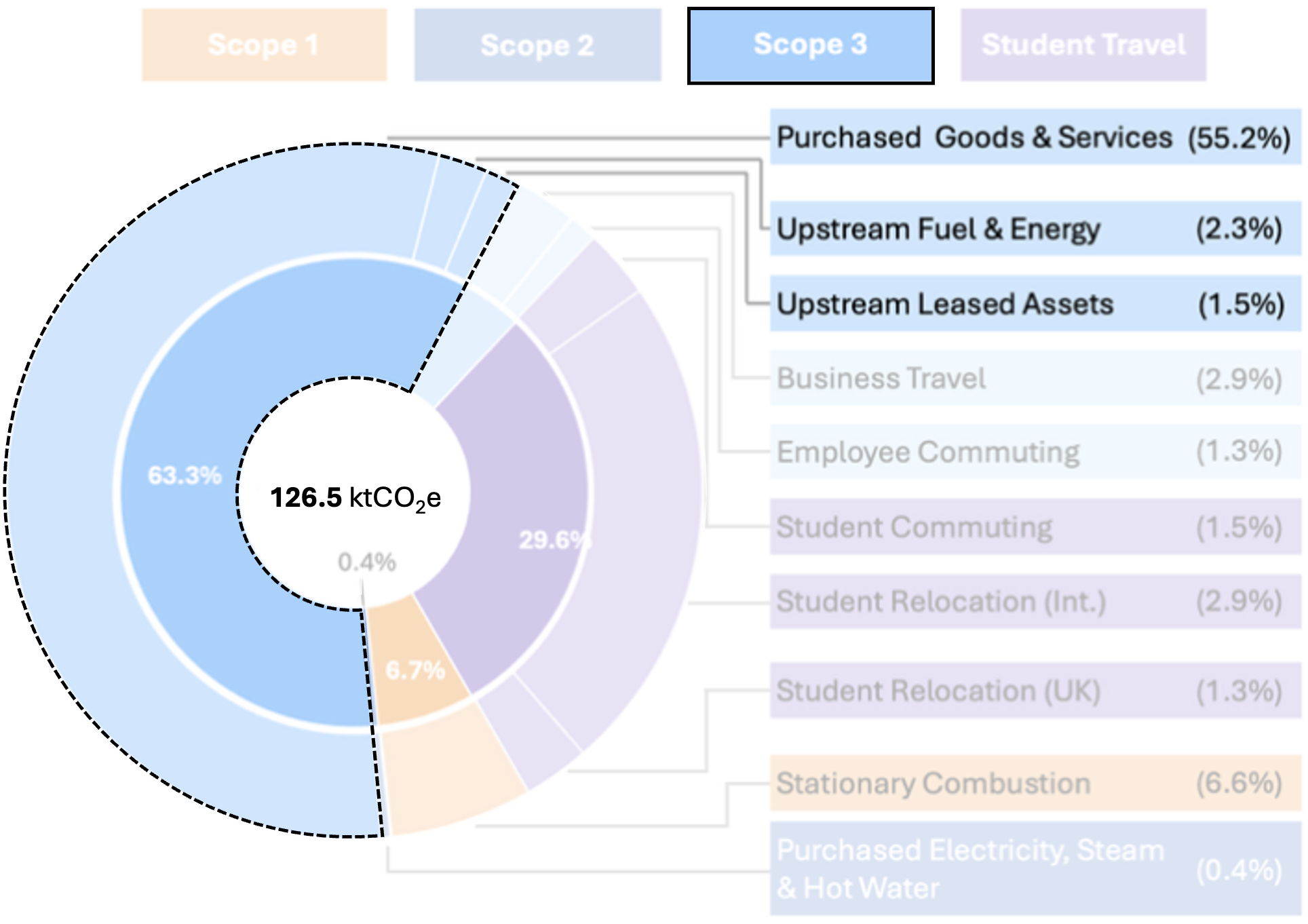
Goal 2 focuses specifically on our total emissions, specifically Scope 3. These emissions include student and staff commuting, business travel and the products we buy and consume.
The University has limited control over these emissions, yet they represent the highest share of the emissions footprint. As it is vital to work towards achieving net zero for Scope 3 we will work collaboratively with our suppliers and University community to reduce Scope 3 emissions through responsible procurement, improved emissions reporting, sustainable purchasing behaviours, and initiatives that minimise waste and support more efficient use of resources.
TARGET: Refine Scope 3 emissions data and reporting, and establish coherent pathways to reduce Scope 3 emissions, through engagement with suppliers and University policy in line with our 2045 net zero target.
Progress Highlights
The University’s latest emissions reporting shows that overall greenhouse gas emissions increased by 26% between 2018/19 and 2024/25. Scope 3 emissions, which account for more than 90% of our total emissions profile, increased by 36% during this period. The largest increases were associated with purchased goods and services and student travel, reflecting the growth of the University and our wider operational activities.
Having supplier types by tier-consumption system we are developing responsible procurement guidance and undertaking Scope 3 analyses to develop rigour in the presented data, methodologies and analyses which affect Scope 3 emissions.
This is a sector-wide challenge for all organisations, and we are developing plans to address this including engaging with key suppliers to reduce emissions and enhance supply side reporting.
GOAL 3: Adopt University and technology sensitive travel emissions pathways to achieve net zero travel
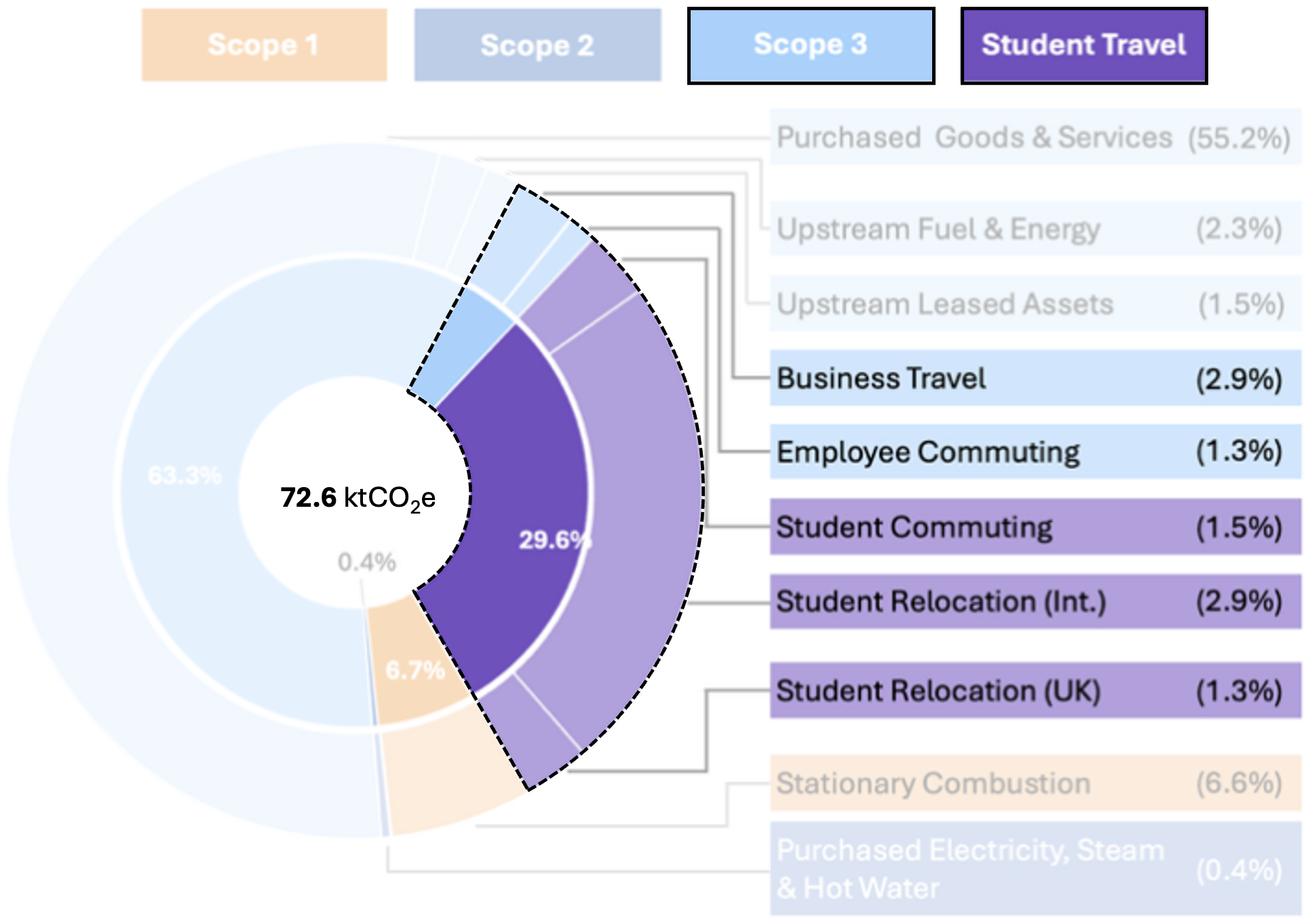
Goal 3 focuses specifically on reducing our emissions from staff and student travel (including international and national student relocation and student commute), whilst maintaining economic and sustainability viability.
TARGET: Deliver evidence-based approaches to reduce travel emissions across all modes of transport for staff and student journeys, consistent with the UK’s CCC pathways and our net zero target of 2045, taking into account the long-term University business and financial sustainability.
Progress Highlights
Employee commuting emissions for 2024-25 have marginally increased since the previous year and are approximately 58% lower than the 2018-19 baseline. Emissions associated with business travel reduced by 24% between 2018/19 and 2024/25, while student travel emissions for 2024-25, were 39% higher than 2018-19, although 42% lower than the previous year.
We have developed revised milestones according to UK Climate Change Committee (CCC) requirements, and evaluated the effectiveness of behaviour change communication campaigns in keeping business travel emissions below the agreed targets.
For the next period, we will develop evidence-based travel policies, promote more sustainable travel choices, improve understanding of travel-related emissions, and establish clear pathways towards reducing travel emissions in line with our Scope 3 net zero emissions target.
GOAL 4: Embed sustainability across the University education and student experience frameworks
Goal 4 focuses specifically on embedding sustainability across all compulsory taught programmes to ensure every student studying at the University will have an opportunity to learn more about sustainability, forming an integral part of their education.
The aim of this Goal is to offer sustainability training to all staff and students as part of orientation enable them to better understand the challenges our planet is facing, including addressing finite resources, environmental, social and economic impacts and how our individual behaviour can be channelled to protect the planet for future generations.
TARGET: Embed sustainability across the university education (skills, career development) and student experience frameworks, supporting students and empowering them to build sustainability thinking into their future lives and careers.
Progress Highlights
-
Development and implementation of the ‘Southampton Sustainability Solutions’ e-learning module, which is available to all staff and students. The module is embedded within induction activities and supports the development of foundational sustainability knowledge and awareness across the University community.
-
Introduction of the interdisciplinary undergraduate module for second and third year students on ‘Global Sustainability Challenges’. The module explores sustainability issues from a multidisciplinary perspective. Students undertaking the module may also contribute to the development of the University’s Meliora Podcast, which received the Next Generation Learning and Skills Award at the 2025 Green Gown Awards.
-
Completion of mapping the United Nations SDGs to all Degree Programmes and compulsory modules across the University. This work identified sustainability-related content embedded within programmes and produced school booklets to support Programme Leads in communicating this information to both current and prospective students.
-
Creation of a Sustainability Programme Approval Toolkit] to assist Programme Leads in identifying, evidencing and enhancing sustainability content within programmes, supporting engagement with the University’s Programme Approval and Review (PAR) process.
-
Development of the Sustainability Skills Digital Resource, highlighting the link between sustainability and employability skills as part of the Successful Futures initiative. The resource supports students in understanding the relationship between sustainability competencies and the skills required for future employment and leadership.
We will continue to embed sustainability throughout education and the student experience by integrating sustainability learning into induction and curricula, expanding opportunities for student engagement and leadership, and equipping students with the knowledge and skills needed to contribute to a more sustainable future.
GOAL 5: Make sustainability a cornerstone of UoS’ research practice and societal impact
Goal 5 focuses specifically on addressing the climate crisis through the University’s research, ensuring our work and outcomes can be a major contributor to addressing the climate crisis, identifying solutions and increasing the world’s knowledge.
Our aim is to have developed and embedded the Sustainability Resilience Institute (SRI) as a cornerstone of the University’s research and impact, with a growing number of researchers aligned to it and even more researchers to be attracted to the University because of our distinctive sustainability research.
TARGET: Ensure our research and practice are environment, climate and socially sensitive with impactful innovations at institutional (Triple Helix), city, regional, national and international levels, propelling us as leaders in sustainability.
Progress Highlights
In 2023 the University established the Sustainability and Resilience Institute (SRI) to bring together inter and transdisciplinary work in sustainability across the University. The SRI has launched the Centre for Post-Graduate Research and has optimised and improved information accessibility contributing to higher sustainability rankings and publishes an in-depth annual report on the UN SDG work the University undertakes.
The University has also continued to strengthen sustainability within research practice through participation in the Laboratory Efficiency Assessment Framework (LEAF) and becoming a signatory to the Concordat for the Environmental Sustainability of Research and Innovation Practice.
We will strengthen our position as a leader in sustainability research by supporting responsible and impactful research practices, enhancing sustainable laboratory standards, increasing research aligned with global sustainability challenges, and recognising the contribution of our research to the Sustainable Development Goals.
GOAL 6: Ensure sustainability is at the core of university operations and finances
Goal 6 focuses specifically on developing and systematically enacting processes and policies to ensure sustainability is at the core of our university operations and finances and help address the sustainability issues that matter to our staff and students.
TARGET: Embed sustainability into all University operations, investments and governance through robust policies, SMART targets, and transparent reporting.
Progress Highlights
A Sustainable Ethical Investment Policy has been published and the University continues to publish its annual Fossil Fuel Exposure Statement. We have drafted a revised and expanded University Environmental and Sustainability Policy focusing on 19 policies across five core areas, including, but not limited to, biodiversity, waste, food, ICT and Equality, Diversity & Inclusion.
We will embed sustainability across University operations and governance by strengthening our policies and reporting frameworks, setting transparent SMART targets, engaging our community in shaping sustainability priorities, and ensuring regular review and accountability for delivering our Sustainability Strategy.
Regarding investments we are creating more stringent policies, putting the underpinning processes in place to further reduce our investment fossil fuel exposure, with aims to establish and publish external annual emissions reporting for 100% of our investment portfolio by 2027.